

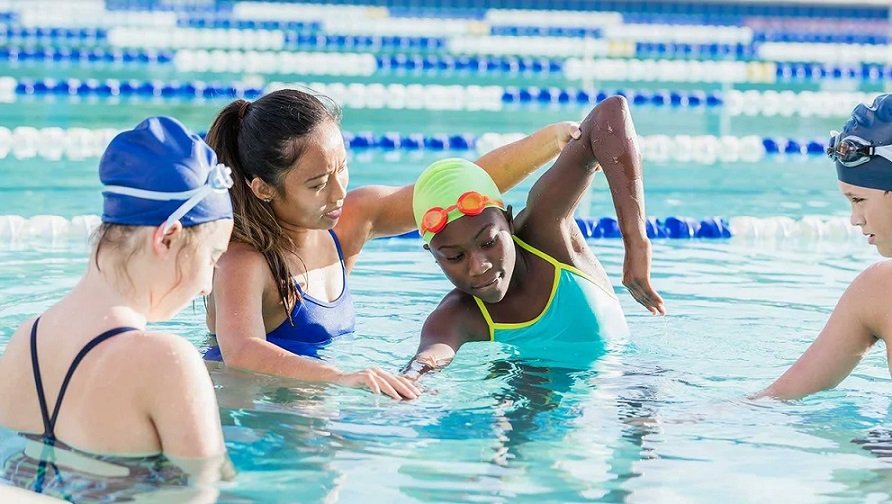
In my experience, private lessons get sold hardest to the people who need them least. A confident eight year old who can already swim a width will improve perfectly well in a group of five, and the parent who paid four times as much for one to one gets a marginally faster result. Meanwhile the terrified adult beginner who genuinely needs individual attention often ends up in a group of eight because it looked like the sensible economy. Here is how I decide which format fits.
What Private Coaching Buys You
A private session buys uninterrupted attention, a pace set entirely by the swimmer, and the ability to spend twenty minutes on one problem without holding anybody up. That matters enormously for adults with a fear of water, for swimmers with a specific stroke fault that keeps recurring, and for anyone preparing for a triathlon or a squad trial. It also matters for children with sensory sensitivities or additional needs, where a group setting adds noise and pressure that get in the way of learning.
Where Group Classes Win
Groups do something private lessons cannot, which is show a swimmer what the next stage looks like. Children copy each other relentlessly and progress faster for it. Groups also cost a fraction as much, which means you can afford twice the frequency, and frequency beats intensity for beginners every time. Two group sessions a week will usually outperform one private session a week at a similar total spend. Looking at private swimming lessons dubai alongside group pricing for the same venue makes that trade-off obvious.
The Hybrid Approach
The approach I recommend most often is a short private block to get past a specific barrier, then a move into a group to consolidate. Four private sessions to fix breathing and floating, followed by a group block to build distance and stamina, delivers better value than either format alone. Adults respond particularly well to this because the private phase removes the embarrassment and the group phase removes the pressure of constant one to one observation.
Cost Per Outcome Rather Than Cost Per Hour
Comparing hourly rates hides the real number. Work out the total cost to reach a defined milestone, such as swimming 25 metres unaided. A group route at AED 90 a session across 24 sessions comes to roughly AED 2,160. A private route at AED 280 across 12 sessions comes to AED 3,360. The private route gets there sooner and costs more. Which one wins depends on whether time or budget is the tighter constraint for you.
Children Versus Adults
Children under six do well in very small groups of three or four, where they get attention and imitation together. Children over six who already swim belong in groups. Adult beginners get the most from semi-private, which sits between the two on price and delivers most of the private benefit. Adults refining technique for fitness or open water are well served by occasional private sessions layered on top of their own training.
How to Compare Fees Honestly
Ask for the per-session price after the block discount, the number of swimmers sharing the coach, and whether pool entry is included. Those three figures let you compare any two providers on equal terms. Searching swimming classes near me with fees and lining up the totals side by side takes twenty minutes and regularly saves a few thousand dirhams across a year.
Semi-Private Is the Format Nobody Advertises
Two or three swimmers sharing one coach sits at roughly half the private rate and delivers most of the attention. Very few providers promote it, because it complicates their timetable, and almost all of them will arrange it if you ask directly and bring your own partner. Two adult friends at a similar level, or two siblings within a couple of years of each other, make ideal pairs. This is the format I recommend most often to nervous adult beginners in the UAE, and it is consistently the best value on the whole price list.
Buy private coaching to solve a specific problem. Buy group lessons to build a habit. The people who mix the two get the most for their money.
