
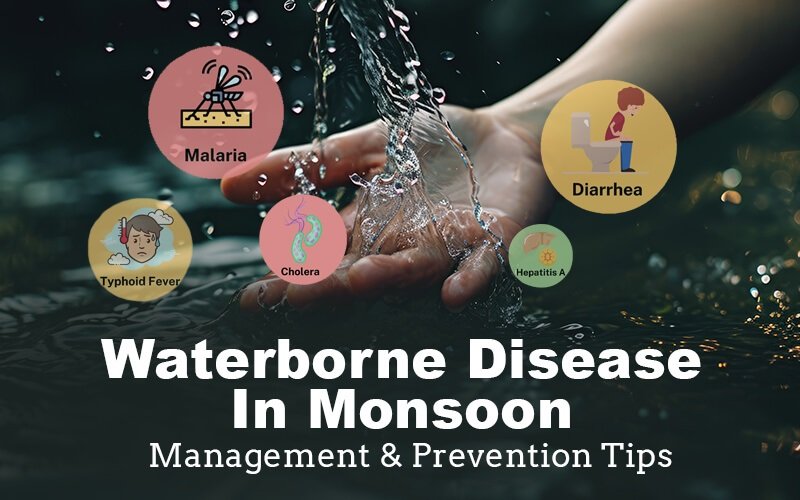
Waterborne diseases peak during the monsoon. The same water quality you have been using since March might change in July as the rains start. You might think something changed at the treatment plant, but the real cause lies in what happens between the plant and your tap. The gap between the tap and the plant is where waterborne diseases increase during the monsoon.
Rain alters pressure and chemistry in the distribution network, making treated water unsafe. The National Health Profile recorded 6.4 million cases of acute diarrhoeal disease in 2021 – the second most prevalent communicable disease in India.
What Diseases are Caused by Contaminated Water in India?
Diseases caused by contaminated water include acute diarrhoea, typhoid, viral hepatitis A and E, bacillary dysentery, and cholera. The main differences lie in the organism and its severity, but faecal matter often reaches drinking water.
It does not necessarily mean the water from a treatment plant is unsafe, but it can become unsafe before it reaches the tap. Monsoon is one of the main reasons behind it.
Why Diseases Peak in the Monsoon, not the Rainfall
Most Indian cities receive water through intermittent piped supplies; hence, it is available for only a few hours. As the water is not available all the time, this is where the monsoon does its damage.
Negative Pressure Leads to Contaminated Water in Pipes
When there is no water supply, the drains are nearly empty. As the water returns and then stops again, the network passes through negative pressure. As a result, a pipe does not push water through cracks. It draws water from whatever surrounds it.
Nelson and Kumpel’s study in Environmental Science and Technology (2014) shows a case in Hubli-Dharwad. There are four ways contamination happens:
1. Biofilm sloughing
2. Contaminant intrusion from the pipe’s surroundings
3. Recontamination in water storage in households
4. Backflow from customer premises
At low pressure, the bacterial indicator spiked even where a chlorine residue was found.
Water Quality Changes Due to What’s Around a Pipe
Year-round, soil usually surrounds the main water pipelines, which are buried underground. As rainfall starts, the flooded trench blends with sewage and runoff. The pathway itself doesn’t change during the monsoon – what changes is what the pipes draw in.
Why Residual Chlorine Fails When Waterborne Diseases Peak
Usually, chlorine-treated water is safe to drink. However, chlorination leaves residue. Free chlorine persists throughout the network and addresses contamination that occurs after treatment.
With rainfall, turbidity increases, which increases chlorine demand at the plant. That’s why more of the dose is spent before the water leaves. Due to the intrusion, the reject water contains organic nitrogen and ammonia, which react with free chlorine on contact. The network carries more contamination than it can handle.
When do Illnesses Caused by Contaminated Water Peak?
Most people expect the risk to be highest when it rains heavily; however, the reality is different.
In Scientific Reports (2016), Kulinkina and colleagues studied the correlation between rainfall and diarrhoeal disease counts across Vellore.
Without any time lag, they found that a tenfold increase in weekly rainfall raised the risk of diarrhoea by 66% at rural sites, with no significant effect detected in urban areas. Applying a three-week lag changed the picture; the risk rose by roughly 40% in urban areas and even more sharply (about 82%) in rural areas.
The three-week lag means the peak of waterborne diseases is after the rain stops. At this point, people have often let their guard down, even though risk remains elevated. The same study also recorded that coliform concentrations in household storage were higher than in the public supply throughout. The tap water was not the worst point in this chain, but the tank was.
Is Boiling Water Enough During the Monsoon?
Boiling water effectively works against waterborne pathogens. Still, boiling water has its limitations; it cannot remove heavy metals, pesticides, or nitrates. However, a household that boils water for drinking but uses untreated tap water to make ice still leaves an exposure gap, since the ice bypasses the boiling step entirely.
What a Water Purifier Removes and How it Helps during the Monsoon
Water contamination during the monsoon season is largely microbiological, but it is often assumed that a bigger membrane might be the ultimate answer.
RO can Only Remove Dissolved Solids
RO is used for TDS, but it does not remove bacteria or viruses. In areas with groundwater supply, TDS levels may exceed the BIS IS 10500 desirable limit of 500 mg/L. UV or UF can detect coliform events, whereas RO cannot. Many water purifier rental plans in high-turbidity regions offer multi-stage RO+UV+UF purifiers.
Turbidity Reduces UV Performance
UV disinfection depends on light actually reaching the organism. Even if the lamp’s output stays constant, suspended particles can shield organisms from the dose. Moreover, sediment filters clog in turbid water. As water quality changes, the water purifier that performed well in March might not deliver the same results in August.
Servicing a Water Purifier before the Monsoon
Timing matters just as much as servicing itself. Filters are usually replaced on a fixed yearly schedule rather than in the season that puts the most load on them. In high-turbidity waters, pre-filters bear the brunt — it’s better to replace them at the beginning of the monsoon.
Why Rented Purifiers Follow Different Cycles
When the water purifier is rented rather than owned, the maintenance cycle is the rental provider’s responsibility. Platforms like Rentomojo offer free filter changes every six months and free maintenance on their rental purifiers. The provider notifies you that the filters need to be replaced.
Final Thoughts
Monsoon does not automatically degrade the water quality. However, pipeline pressure, changes in rain patterns, and other factors can affect water quality before it reaches you. If you notice high turbidity or high TDS during the monsoon, choosing a good water purifier for home may be crucial. You should compare purification technologies and choose a water purifier matched to your TDS levels.
